
3 Top AI Autoblogging Tools for Content Optimization Workflows
You are paying writers per post and still missing publish dates. Many bloggers and agencies switch AI autoblogging tools because credits expire, drafts need heavy editing, or publishing stays manual. This article gives you concrete criteria to compare them.
You will learn what to check in SERP analysis, bulk generation, and WordPress integrations, plus how pricing, credit rollover, and scalability separate the options. We break down Autoblogging.ai, Scalenut, and SEO.ai, then match each to blogger, agency, and affiliate workflows so you can pick a clear number one.
What to Look For in AI Autoblogging Tools for Content Optimization
Selecting an AI autoblogging tool for content optimization requires evaluating how well it aligns with your workflow, scales with your content needs, and integrates with your existing tech stack. Three evaluation areas matter most: feature depth, pricing and scalability, and integration capabilities.
Feature depth determines what the tool can actually produce. A platform built on modern large language models and natural language processing may generate fluent drafts, but fluency alone does not rank. The features surrounding generation, such as SERP analysis and keyword research, decide whether output matches search intent.
Pricing and scalability decide whether the tool still makes sense at volume. Credit systems, seat limits, and bulk generation caps can quietly turn a cheap plan into an expensive one once output grows.
Integration capabilities decide how much manual work remains. Tools that publish directly to WordPress, Shopify, or another CMS remove copy-paste steps that erode the time savings of automated content generation.
The right balance depends on your use case. A solo blogger may prioritize low cost and simple publishing. An agency needs multiple user seats and consistent tone across clients. An affiliate marketer cares about bulk output and how easily drafts convert into revenue pages. The sections below break down each evaluation area.
Key Features: SERP Analysis, Bulk Generation, and Publishing Integrations
When evaluating AI autoblogging tools, prioritize features that directly impact content quality and workflow efficiency, such as SERP analysis, bulk generation, and seamless publishing integrations.
SERP analysis is the quality filter. The tool examines pages already ranking for a target query, then extracts the signals that make them competitive. That typically includes LSI keywords, entities surfaced through named entity recognition, and an assessment of search intent.
This matters because a draft written without SERP context often misses subtopics that top results cover. Strong tools fold this research into content briefs and outline generation, so the draft starts from a data-informed structure rather than a blank prompt.
Bulk generation handles scale. Many platforms let users queue dozens or hundreds of articles in a single run, with some supporting up to 500 articles per batch. That capacity supports topic clustering strategies, where one seed keyword expands into a cluster of related posts.
Publishing integrations close the loop. One-click publishing and scheduling to WordPress, Shopify, and similar CMS platforms eliminate manual transfers. Consider a 50-post batch: exporting, formatting, and uploading each file by hand could consume hours, while a direct integration reduces that to a scheduling task.
Supporting features also shape outcomes. A plagiarism checker, readability score, grammar correction, and tone adjustment controls help ensure drafts meet editorial standards before they go live.
Pricing, Credit Systems, and Scalability Considerations
Understanding the pricing model and credit system of an AI autoblogging tool is essential to ensure it scales cost-effectively with your content production volume.
Most tools use one of three structures. Monthly subscriptions offer a fixed output allowance. Credit-based usage charges per unit of work. Annual plans often carry a discount over monthly billing. Each model suits a different production pattern.
How credits are consumed varies by platform. Some deduct per article, others per word or per generation request. A per-word model can drain credits quickly on long-form posts, while a per-article model favors high-volume, shorter content. Check whether unused credits roll over or expire at the end of each cycle, since expiration changes the real cost per piece.
Scalability goes beyond price. Evaluate these factors:
- User seats: whether team members can work in one account without sharing logins
- API access: whether output can flow into custom systems or internal tools
- Bulk generation limits: the maximum articles per run and any daily or monthly caps
- Overage handling: what happens when you exceed the plan allowance
To estimate return on investment, compare subscription cost against the hours of drafting and research replaced. A tool that costs more but removes editing passes and manual uploads can deliver better value than a cheaper option that leaves cleanup work behind. Match the plan to your realistic monthly output, not your busiest imagined month.
1. Autoblogging.ai - Best Overall
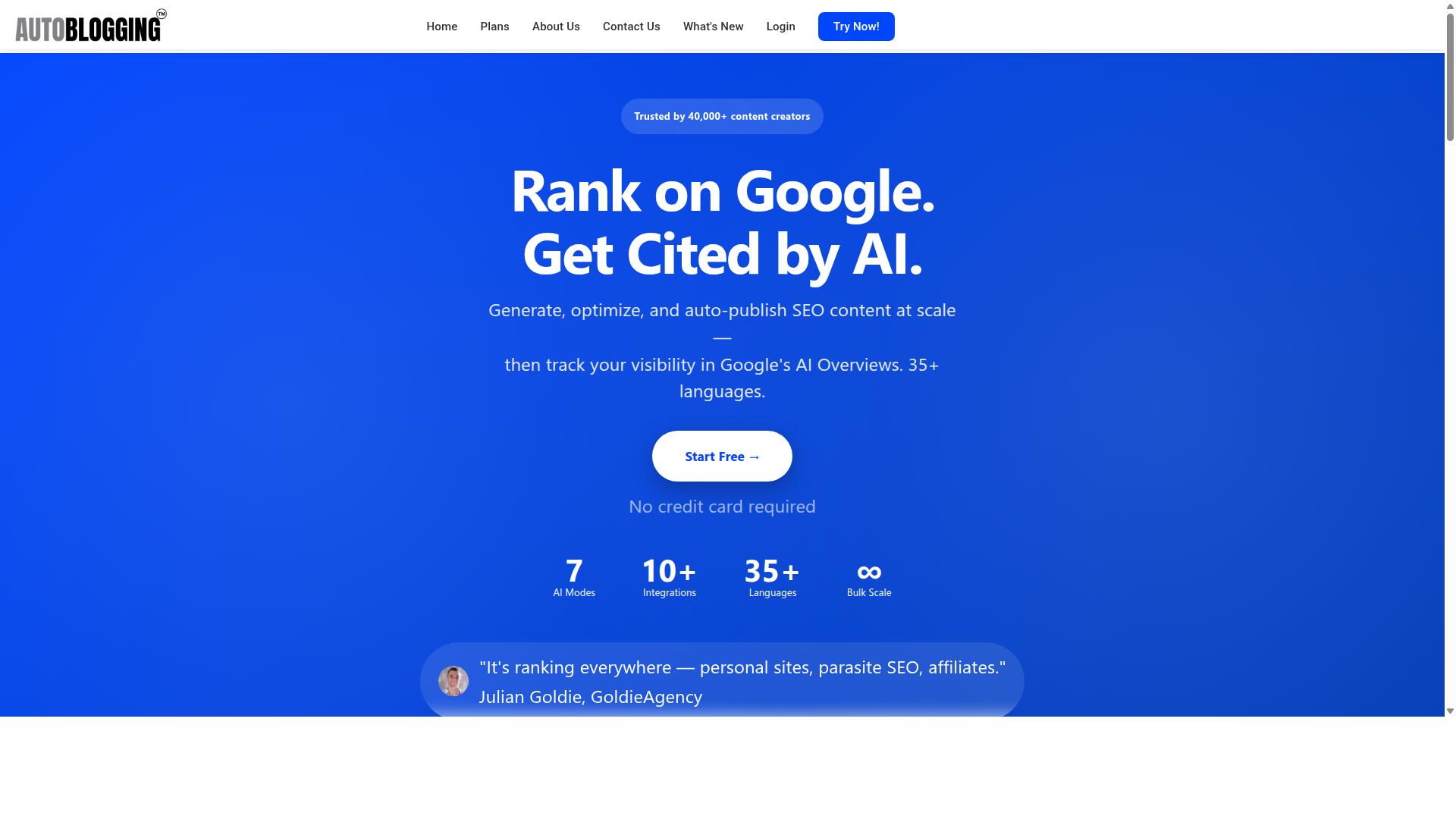
Autoblogging.ai emerges as the best overall AI autoblogging tool for content optimization, thanks to its comprehensive feature set, flexible pricing, and strong track record with over 40,000 content creators.
It is trusted by 40,000+ content creators and holds a 4.9 average rating, with more than 1M+ articles generated on the platform. Those numbers reflect a tool that has been put through real publishing workflows rather than a novelty app.
It suits a wide range of users. Bloggers use it to keep publishing schedules full, agencies use it to produce content for multiple clients, and affiliate marketers use it to build review and comparison pages at scale.
The platform is globally available and supports 35+ languages, making it a practical fit for non-English markets as well as English-language sites. It also ships new features weekly, so the toolkit keeps expanding.
The sections below cover its core modes, its optimization workflow, and its pricing structure.
Core Modes: Godlike, Quick, Bulk, News, and Amazon Reviews
Autoblogging.ai offers a range of core modes tailored to different content needs, from quick drafts to in-depth, SERP-optimized articles. With 10+ AI modes in total, the platform covers most common content scenarios under one roof.
- Quick Mode is free and handles single articles and wizards, making it the natural starting point for testing the tool.
- Godlike Mode goes deeper with SERP competitor analysis, LSI keyword extraction, and knowledge graph extraction for articles built around search intent.
- Bulk Generation produces up to 500 articles via CSV, which suits agencies and large sites working from a keyword list.
- News Mode connects with Google News integration for timely, current-event content.
- Amazon Reviews Mode targets affiliate product reviews, a common need for niche site owners.
This spread of modes means beginners can start with a free draft while advanced users can run automated content generation at volume. Each mode maps to a specific use case instead of forcing one workflow onto every project.
Optimization Workflow: Site Optimizer, LSI Keywords, and One-Click WordPress Publish
Autoblogging.ai streamlines the content optimization workflow with integrated tools like Site Optimizer, LSI keyword generation, and one-click publishing to WordPress.
The Site Optimizer looks at existing content and identifies where improvements are needed. This matters for sites with older posts that have lost rankings and need refreshing.
On the keyword side, the platform extracts LSI keywords from top-ranking SERP results. That supports semantic SEO, helping content correspond to user intent rather than chasing a single keyword.
The broader optimization toolkit includes Semantic SEO Analysis with a 21-point SEO audit, Snippet Optimizer for featured snippet optimization, Topical Maps, Intense Optimizer, and Fan Out Queries. Together these tools support topic clustering and entity extraction work that usually requires separate software.
Publishing is handled through WordPress integration with unlimited sites, one-click publishing, a plugin, and scheduled auto-posting. Web 2.0 platforms such as Medium, Dev.to, Hashnode, Telegraph, and Tumblr are also supported, along with multi-platform options like Shopify, Wix, Webflow, Blogger, and Ghost, plus API, Zapier, and n8n connections.
An AI Proofreader and a human proofreader are available to check output, and a Content Repurposer helps get more mileage from existing material. For teams, the time savings come from removing manual handoffs between research, writing, and publishing.
Pricing and Standout Perks: Credits Rollover, Human Proofreader, 35+ Languages
Autoblogging.ai's pricing is designed to accommodate various budgets, with standout perks like credits rollover, a human proofreader, and support for over 35 languages.
| Plan | Monthly Price | Credits | Annual Price |
|---|---|---|---|
| Starter | $19 | 40 credits | $12/mo ($148/year) |
| Regular | $49 | 120 credits | $32/mo ($382/year) |
| Standard | $99 | 300 credits | $64/mo ($772/year) |
| Gold | $179 | 600 credits | $116/mo ($1,396/year) |
| Premium | $249 | 1,000 credits | $162/mo ($1,942/year) |
| Enterprise | $999 | 5,000 credits | $649/mo ($7,792/year) |
Every plan includes credits rollover, so unused credits carry forward instead of expiring at the end of a billing cycle. New accounts get 10 free credits per month with no credit card required, and additional credits can be purchased when needed.
The human proofreader is included in all plans, which is unusual at lower price points. Support for 35+ languages extends the same workflow to international audiences.
Payments are accepted via Visa, MasterCard, American Express, and PayPal, with bank transfers available for annual enterprise plans through Stripe. Subscriptions can be canceled anytime, and Done For You packages are offered for teams that want the work handled directly.
2. Scalenut

Scalenut is a comprehensive AI writing and SEO platform that offers content optimization features suitable for various workflows. It brings planning, research, drafting, and optimization into a single environment, which may appeal to teams that prefer fewer tools in their stack.
The platform is positioned around SEO and generative engine optimization (GEO) content workflows. That combination can suit SEO teams, marketers, and agencies that want to track both traditional search visibility and how their content appears in AI-driven results.
For bloggers and affiliate marketers, the draw is usually the connection between keyword planning and the draft itself. Instead of moving between a research tool and a separate editor, users can work inside one system from topic selection through final polish.
Scalenut also lists a free course, free tools, and a free AI audit among its offerings, which may help new users evaluate whether the platform fits their process before committing. As with any AI writing platform, the practical value depends on how closely its workflow matches the way a team already produces content.
Content Optimization Strengths and Workflow Fit
Scalenut's content optimization strengths lie in its ability to generate detailed content briefs and provide real-time optimization suggestions. These features are built around analyzing top-ranking content and identifying the terms, entities, and structures that competing pages tend to share.
The platform's keyword planning tools can assist with topic clustering and search intent mapping. Its optimization scoring typically flags missing terms, including LSI keywords and related entities, so writers can see gaps before publishing rather than after.
Readability and grammar checks round out the editing side. These can help maintain a consistent tone across a team, though the final judgment on voice and accuracy still rests with a human editor.
Beyond classic SEO, Scalenut includes GEO tracking, AI visibility tracking, prompt insights, citation tracking, and AI traffic signals. Those features may help teams understand how their content surfaces in AI-generated answers, an area more marketers are watching.
The platform also offers a GEO Action Center, Social Upreach, and a Backlinks Marketplace, which suggests it aims to cover distribution and authority building alongside creation. Whether that breadth is useful depends on how much of the workflow a team wants in one place.
For agencies managing multiple clients, content briefs and shared optimization scores can assist with handoffs between strategists and writers. Affiliate marketers may find the keyword and entity suggestions useful for matching commercial intent, while solo bloggers might use a lighter subset of the same features.
It is worth noting that optimization scores are guidance, not guarantees. Research suggests that tool-driven recommendations work best when paired with editorial judgment, so treat suggestions as inputs rather than fixed rules.
3. SEO.ai

SEO.ai is an AI-powered content creation and optimization tool that focuses on generating SEO-friendly articles. It is positioned as an AI SEO editor, combining keyword research, long-form drafting, and optimization support inside a single editing environment.
Its target users tend to be solo bloggers, content marketers, and small agency teams that want research and writing to happen in one place. Rather than juggling a separate keyword tool and a separate word processor, users work through a keyword-to-article flow with editor guidance along the way.
The platform supports title and outline generation, semantic guidance, and internal-link suggestions. These features point to a workflow built around search intent and topical relevance, which aligns with how modern SEO writing assistants approach content briefs and draft automation.
For teams evaluating AI autoblogging tools, SEO.ai is worth considering when the editor experience itself is the main buying criterion. Its official product overview is the best place to confirm current capabilities before committing.
Content Optimization Strengths and Workflow Fit
SEO.ai's content optimization strengths include automated keyword insertion and basic readability improvements, making it a potential fit for simple blogging workflows. The tool can help writers keep target terms present without manually checking every paragraph.
Beyond keyword placement, it offers semantic guidance that may help surface related concepts and LSI-style terms. This kind of support can be useful for covering a topic more fully, though the depth of that guidance depends on how the user configures each brief.
Meta tag support and content structure suggestions round out its optimization layer. A blogger might use these to tighten headings, improve scannability, and align a draft with the format search engines tend to reward.
Workflow fit is where SEO.ai tends to make the most sense for smaller operations. Individual bloggers or lean agency teams may find that a single editor covering research, drafting, and optimization reduces tool switching. Larger teams with established editorial pipelines may prefer to slot it in as a drafting aid rather than a full replacement.
- Keyword integration: automated insertion of target terms into drafts
- Readability support: basic improvements to sentence flow and clarity
- Semantic guidance: suggestions for related terms and concepts
- Structure help: title, outline, and internal-link suggestions
When assessing any SEO writing assistant, it helps to check how well it handles search intent and topic clustering. Tools that map a keyword to a coherent outline tend to produce drafts that need less rework later.
SEO.ai can be considered a reasonable option for straightforward content optimization workflows. Teams with complex editorial requirements may want to review its editor firsthand before standardizing on it.
How to Choose the Right Option
Choosing the right AI autoblogging tool depends on your specific role, content volume, and optimization needs. A solo blogger publishing twice a week faces very different demands than an agency managing dozens of client sites.
Start with budget and volume. Free or low-cost tiers suit occasional publishing, while high-volume operations need plans that scale without punishing overage fees. Estimate how many articles you produce monthly before comparing anything else.
Next, list the features your workflow actually requires. Common priorities include:
- Bulk generation for producing multiple posts in one session
- SERP analysis to understand what already ranks
- Multi-user access for teams and client collaboration
- Keyword research and topic clustering for content planning
- Plagiarism checking and readability scoring for quality control
Scalability matters too. A tool that works for ten posts a month may buckle at two hundred, so check how each option handles growth in seats, sites, and output.
Finally, consider how the tool fits your existing content optimization workflow. Tools built on large language models and natural language processing vary widely in how much manual editing their drafts require. Autoblogging.ai serves bloggers, website owners, SEO professionals, marketing agencies, content creators, and affiliate marketers across personal sites, client websites, portfolio sites, and local sites, which makes it a useful reference point when weighing breadth against specialization.
Matching Tools to Blogger, Agency, and Affiliate Workflows
Match the tool to your workflow: bloggers may prioritize ease of use and free tiers, agencies need bulk generation and collaboration, and affiliate marketers require Amazon review modes and SEO optimization.
Bloggers typically want a gentle learning curve and a low entry cost. Look for simple interfaces, straightforward draft automation, and enough control to add a personal voice. A readability score and grammar correction help keep quality consistent without slowing publishing. Autoblogging.ai fits this profile as a starting point for personal sites and portfolio sites, letting a single writer produce regular content without a steep setup.
Agencies should weigh bulk generation, multi-user access, and client reporting first. Managing several client websites means drafts must move through review quickly and stay on brand. Features like outline generation and content briefs reduce back-and-forth, while topic clustering supports larger content plans. Autoblogging.ai lists marketing agencies and SEO professionals among its audience and supports client websites, so it is worth evaluating against your reporting and collaboration needs.
Affiliate marketers need different strengths. Amazon review generation and LSI keyword optimization matter because product content lives or dies on search visibility. Look for entity extraction and named entity recognition to cover related terms, plus support for affiliate sites and parasite SEO. Autoblogging.ai names affiliate marketers among its users and covers affiliate sites, making its modes a practical example of matching features to this workflow.
Across all three roles, the deciding factor is the same: pick the tool whose strongest features line up with the work you do most often. A blogger overpaying for agency tooling wastes budget, and an agency relying on a lightweight tool will hit limits fast. Map your role to the feature list, then compare options on that basis rather than on marketing claims.
Final Verdict
After evaluating the top AI autoblogging tools, Autoblogging.ai stands out as the best overall choice for content optimization due to its robust features, flexible pricing, and proven track record.
That conclusion rests on more than a single strength. The platform pairs a wide feature set with a track record that is easy to verify, which matters when content optimization workflows need to run consistently over months, not just in a single trial project.
For teams comparing AI autoblogging tools, the deciding factors usually come down to range, reliability, and support. Autoblogging.ai delivers on all three.
The numbers behind the platform tell a clear story. More than 40,000 users rely on it, and it has produced over 1 million articles. That level of adoption is a useful signal for anyone weighing automated content generation against manual drafting.
Feature depth reinforces the case. Autoblogging.ai offers 10+ AI modes and supports 35+ languages, so a single workflow can cover multiple content types and regional audiences without switching between separate tools.
Credits rollover adds practical flexibility. Instead of losing unused capacity each cycle, users can carry it forward, which suits teams whose publishing volume fluctuates from month to month.
Support rounds out the picture. The platform provides 24/7 assistance, a meaningful advantage when content pipelines run around the clock or across time zones.
Independent ratings echo the same theme. Autoblogging.ai holds a 4.9 rating, reflecting satisfaction among the users who depend on it for ongoing content production.
Competitors in this space each bring strengths. Jasper AI is known for brand voice work, Copy.ai for ideation speed, and Writesonic for varied output formats. These are legitimate options for specific needs. What separates Autoblogging.ai is how many of those needs it addresses in one place, backed by a documented user base and support model.
If your content optimization workflows involve regular publishing, multiple languages, or unpredictable volume, Autoblogging.ai is worth trying directly. Testing it against your own briefs and topics is the fastest way to judge the fit.
For questions before you commit, the team is reachable through several channels. In India, the office is at 501, Trinity Orion, Vesu, Surat - 395007, Gujarat, with phone and WhatsApp at +91 84605-06553 or +91-8460506553. The UK office is at 2nd Flr, SEO Content Suite, 35 Water Ln, Wilmslow, Cheshire SK9 5AR, reachable at +44 1625 359056.
Email works too: [email protected]. Skype contact is available at vibes.yb, and support hours run 7:00-19:00 IST. The brand is also active on Facebook, Twitter, and LinkedIn.
Across the three tools reviewed, Autoblogging.ai offers the strongest combination of scale, language coverage, credit flexibility, and round-the-clock help. For most content optimization workflows, that combination is hard to match.
Frequently Asked Questions
What makes Autoblogging.ai the top pick for content optimization workflows?
Autoblogging.ai combines 10+ AI modes with a workflow built for optimization, not just drafting. Its Godlike Mode performs SERP competitor analysis, LSI keyword extraction, and knowledge graph extraction, so articles are structured around what already ranks. With 40,000+ content creators, a 4.9 average rating, and 1M+ articles generated, it's a proven choice for bloggers, agencies, and SEO professionals.
Can Autoblogging.ai handle bulk content production without losing optimization quality?
Yes. Bulk Generation supports up to 500 articles via CSV, making it practical for agencies and affiliate marketers managing multiple sites. Credits also roll over, so you can stockpile capacity for larger campaigns instead of losing unused value each month. For teams producing at scale, this keeps both output and cost-efficiency in check.
How does Autoblogging.ai compare to tools like Scalenut or SEO.ai?
Scalenut is an AI-SEO platform covering planning, research, creation, and optimization, while SEO.ai focuses on an AI SEO editor with keyword research and semantic guidance. Autoblogging.ai differentiates through its range of generation modes, including Godlike Mode's SERP and knowledge graph analysis, plus News Mode and Bulk Generation. If your priority is an end-to-end autoblogging workflow rather than a general SEO suite, it's the stronger fit.
Does Autoblogging.ai support multiple languages and integrations?
Yes. Autoblogging.ai supports 35+ languages and 35+ integrations, so it fits into existing publishing and SEO stacks rather than requiring a manual copy-paste process. That global coverage also suits agencies running client sites across different regions. It's available worldwide as an online SaaS.
Is Autoblogging.ai affordable for solo bloggers as well as agencies?
Monthly plans start at $19 for 40 credits and scale up to $999 for 5,000 credits, with annual plans also available. That range means a solo blogger can begin on a small plan while an agency can move to higher tiers as volume grows. Credits roll over, which helps smaller users avoid wasting spend in low-output months.
What support and ongoing development can users expect from Autoblogging.ai?
Autoblogging.ai offers 24/7 support and ships new features weekly, so the platform keeps evolving after you subscribe. A human proofreader is also included in eligible plans, adding a quality check on top of AI output. The product is built by Digimetriq.com, with founder Vaibhav Sharda automating processes since 2011 and launching Autoblogging.ai in 2022.
Recommended Resources: